Ganesh Visarjan and Your Phone: The Procession, the Ghat, the Water

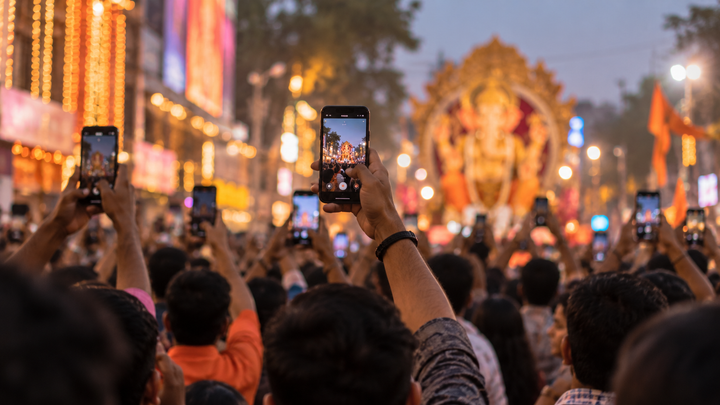
The dhol has been going for three hours. The idol is moving. Everyone around you has a phone up, filming over their own head, and the crowd is moving as one body towards the water.
Visarjan is the only day in the year that stacks all three phone hazards into a single afternoon: a dense moving crowd, a slippery wet edge, and deep water with no recovery path. They are not one problem. They fail at different moments, in different ways, and the thing that helps with the first does nothing for the last.
When Visarjan 2026 actually happens
Ganesh Chaturthi 2026 falls on Monday 14 September, and the main immersion, Anant Chaturdashi, is Friday 25 September. Households immerse on different days depending on the vow they keep:
- One and a half day: 15 September
- Three day: 16 September
- Five day: 18 September
- Seven day: 20 September
- Ten day, Anant Chaturdashi: 25 September
Local muhurat timings vary by city and by mandal, so treat these as the days rather than the hours. The crowd scale is not evenly spread across them: the tenth day is the one where a neighbourhood procession becomes a city-wide one.
The procession is a crowd problem
Almost nobody loses a phone to a thief here. They lose it to physics.
The characteristic visarjan drop happens with the arm fully extended overhead, filming the idol or the dhol-tasha pathak over the heads in front. That is the weakest grip position a hand has, and it is the position everyone holds for minutes at a time. When the phone goes, it does not fall at your feet. It falls into a moving crowd and is kicked out of reach within seconds.
Do not bend down for it. In a procession that is still moving, going down to floor level is how crush injuries start. A phone is replaceable in a way that this is not. If it is gone, let it be gone and deal with it afterwards.
Gulal is the part nobody accounts for
This is the specific thing that makes visarjan different from any other crowd.
Colour powder plus sweat turns a phone back and a palm into two surfaces that no longer hold each other. People describe it as the phone "just going", and they are not being careless: the grip that was fine at the start of the procession is genuinely not the same grip two hours in.
- It kills grip, which is the actual mechanism behind most of the drops.
- It gets into ports and speakers, and fine powder in a charging port is a real repair, not a cosmetic one.
- It hides screen damage, so people do not notice a crack until they clean the phone that night.
A case with texture helps more than a bare phone. Wiping your hand on a dry cloth before you raise the phone helps more than most people expect.
The ghat is a water problem
At the immersion point the failure mode changes completely, and it gets worse.
The steps are wet from thousands of people before you. There is usually a surge as the idol goes in, and that surge happens at exactly the moment everyone raises a phone to film. A phone dropped here does not get kicked away. It goes into water that is deep, silty and full of people.
Do not go in after it. Immersion sites have sudden drop-offs, poor visibility and crowds at the edge, and people die at visarjan sites every year. No phone is worth entering that water for, and this is the single most important line in this article.
Artificial immersion tanks, now common in Mumbai, Pune and Hyderabad, are shallower and better lit, which genuinely lowers the risk. They do not remove it: the crowd pressure at the tank edge is often higher because the space is smaller.
City by city
| Where | The specific risk | What to do |
|---|---|---|
| Girgaon Chowpatty, Mumbai | Sand, night crowds, sea water at the end of a long procession | Phone away for the last stretch to the water. Salt makes recovery far less likely |
| Lalbaugcha Raja procession | Hours of dense standing crowd, arms overhead, heavy gulal | Tether while filming, wrist strap over hand-held, both hands when the crowd moves |
| Tank Bund and Hussain Sagar, Hyderabad | Long queues of idols, crane immersion, spectators pressed to the railing | Film from behind the railing, not over it |
| Pune dhol-tasha pathaks | Dancing, jostling, phone out for long stretches in low light | Accept you will not get a steady shot. Short clips, phone down between them |
| Artificial immersion tanks | Tighter space, higher crowd pressure at the edge | Do not lean over the tank wall to film the idol going under |
| Neighbourhood river and lake ghats | Unlit, uneven, slippery steps, no barrier | Torch on, phone in a zipped pocket on the steps themselves |
If it goes in the water and you get it back
- Do not charge it. Power through a wet port is what turns a recoverable phone into a dead one.
- Power it off and leave it off.
- Do not shake it or press buttons, which moves water further inside.
- If it went into the sea, rinse briefly in clean fresh water, then dry the outside. Salt left in place keeps corroding.
- Leave it upright somewhere warm, dry and airy for a day or more. Rice does not work and adds dust to the ports.
- Then a technician, not a charger.
If it is gone for good
Block the IMEI through the government CEIR portal on Sanchar Saathi, not just the SIM. A blocked IMEI makes the handset useless on Indian networks, which is the only step that actually matters. File the police complaint, because the portal asks for it.
Do this the same night if you can. Immersion evenings also bring heavy network congestion in the areas around the ghats, so do not count on being able to sort it out standing there.
The practical version
- Carry less. One card or some cash, not a full wallet, and not two phones.
- Zipped pocket, front, not back.
- Attached to you whenever it is out. A wrist tether means a slipped phone swings instead of disappearing underfoot.
- Phone away entirely for the last approach to the water. That stretch is where both problems overlap.
- Agree a meeting point with whoever you came with, out loud, before the procession starts. Phones fail as a plan on this specific day.
What a tether does not do here
We make one, so the limits matter more than the pitch.
A tether covers exactly one thing: the phone in your hand, in the moment your grip fails. That happens to be the most common visarjan loss, which is why it is worth wearing. It does nothing for a phone already in the water, nothing for a phone in a back pocket, and nothing about the crowd itself.
It is also not a reason to hold the phone further out over a tank wall or a railing. If it changes how far you reach, it has made your day worse, not better.
Frequently asked questions
When is Ganesh Visarjan in 2026?
The main immersion, Anant Chaturdashi, is Friday 25 September 2026. Ganesh Chaturthi is Monday 14 September, and households also immerse on the one and a half, three, five and seven day marks, which fall on 15, 16, 18 and 20 September.
How do most people lose a phone at Visarjan?
Not to theft. The common loss is a phone slipping from a hand raised overhead to film, in a crowd that is moving, after gulal and sweat have destroyed the grip. Once it lands it is kicked out of reach within seconds.
Should I go into the water to get my phone back?
No. Immersion sites have sudden drop-offs, poor visibility and heavy crowd pressure at the edge, and people die at them every year. Treat the phone as gone and block the IMEI instead.
Does gulal damage a phone?
It can. Fine colour powder works its way into charging ports and speaker grilles, which is a genuine repair rather than a cleaning job. Its bigger effect is on grip, which is what causes the drop in the first place.
What should I do if my phone is stolen or lost during the festival?
Block the IMEI through the CEIR portal on Sanchar Saathi and file a police complaint, which the portal requires. Blocking the SIM alone does not stop the handset being used.
One hand for the dhol, one for the phone, and nothing left to catch it with. See how PHLOOP works →
Related reads

Enjoyed this? Get the next one.
Join the PHLOOP list for new guides, product drops, and announcements. No spam.
Keep reading