Where Indian Travellers Actually Lose Phones: 12 Situations, Ranked

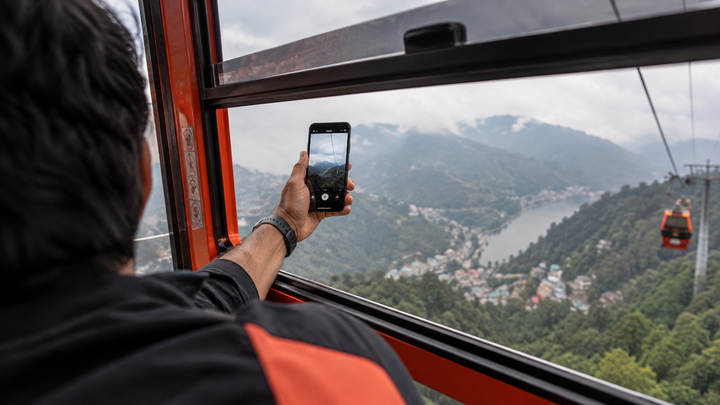
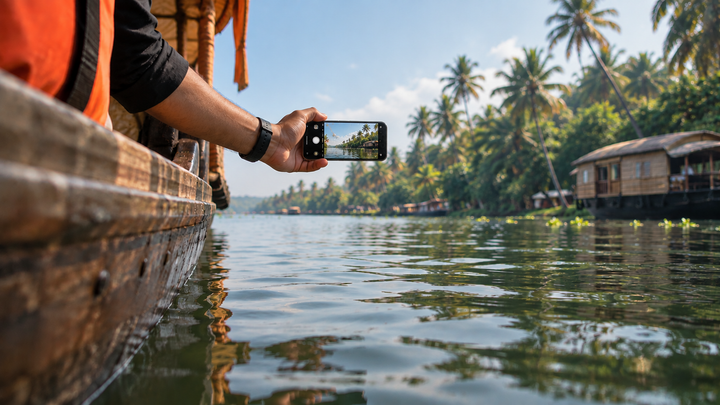
Every travel guide tells you what to see. None of them mention that the viewpoint has no railing, that the shikara sits level with the water, or that the cable car door has a gap under it.
The useful question is not where you are most likely to drop a phone. It is where a dropped phone is gone for good. Those are different lists. A phone dropped on a fort path is a repair bill. A phone dropped off a boat is every photo from the trip, your boarding passes and your bank access, all at once. Here are twelve situations, ranked by whether you get it back.
Recoverable, or gone
Sort every travel phone loss by one question: after it leaves your hand, can you physically retrieve it?
Gone means water, a long drop into inaccessible ground, or a moving vehicle you cannot stop. You do not get a second chance, and no case, screen protector or insurance excess changes the outcome.
Recoverable means it hits ground you can walk to. You pick it up, and the question becomes what the screen costs. Unpleasant, but survivable, and our repair cost pages will tell you roughly what you are looking at.
Almost all travel advice treats these as the same event. They are not remotely the same event.
The twelve, ranked
| # | Situation | Outcome | What actually helps |
|---|---|---|---|
| 1 | Shikara, houseboat or backwater boat | Gone | Tether, or phone stays in a zipped bag |
| 2 | Ferry deck, especially at the rail | Gone | Photograph from behind the rail, not over it |
| 3 | Ropeway or cable car | Gone | Never hold it near the door gap or window |
| 4 | River rafting | Gone | Dry bag only; a tether is not enough here |
| 5 | Waterfall viewpoints and wet rock | Gone or destroyed | Tether, and accept wet hands grip badly |
| 6 | From a moving two-wheeler or auto | Usually gone | Stop before you take it out. Not negotiable |
| 7 | Train doorway or window seat | Usually gone | Step back from the door to use it |
| 8 | Beach and surf line | Gone, or sand-killed | Leave it further up the beach |
| 9 | Fort parapets, cliff viewpoints | Sometimes gone | Tether, and stand a step back |
| 10 | Crowded festival or market | Recoverable or taken | Front pocket, tether when it is out |
| 11 | Restaurant table, hotel room | Recoverable | A habit, not a product |
| 12 | Temple cloakroom or queue | Recoverable | Label it, and check before you leave |
Notice the shape of that table. The top eight are the ones worth changing behaviour for, and only three of them are about theft.
Water is a different category entirely
It is worth separating out, because people underestimate it constantly.
A modern phone with an IP rating survives rain and a splash. It does not reliably survive being submerged in a lake, and it certainly does not survive not being found. Water resistance is about the phone continuing to work if you retrieve it quickly. It says nothing about retrieval, and in open water retrieval is not happening.
Salt water is worse again. Even a phone fished out immediately from the sea is on a clock, because salt keeps corroding after it dries.
So on any boat, the decision is binary: either the phone is physically attached to you, or it is zipped away. Held loosely over the side while you frame a shot is the one position with no recovery path.
The three seconds most of these share
Strip the situations down and the same sequence appears.
- You stop to take a photo, so you are stationary and your attention is entirely on the screen.
- You extend the phone past a boundary - a rail, a ledge, a window, the side of a boat - because that is where the view is.
- Something small changes. The boat shifts, someone bumps you, the cable car lurches, your wet hand slips.
The phone is not dropped because you were careless. It is dropped because you deliberately held it in the one place where dropping it is unrecoverable, which is also the only place the photograph exists.
What actually helps, honestly
Ranked by how much difference each makes for how little effort.
- Do not photograph over a boundary with an unsupported hand. Brace your forearm on the rail rather than reaching past it. This single habit covers most of the top eight.
- Keep it attached while it is out. A wrist tether means a slipped grip is a swing rather than a fall. This is what we make, and it is the correct tool for situations 1, 2, 5 and 9.
- Dry bag for anything genuinely wet. Rafting and rough sea crossings are not tether territory. The phone should not be out at all.
- Back up before you travel, not after. The photographs are usually worth more than the handset, and that is the part no accessory protects.
- Record your IMEI before you go. Dial *#06#. If the phone is stolen rather than dropped, you will need it.
What a tether does not do
We sell one, so here is the limit stated plainly.
A wrist tether covers the phone while it is in your hand. It does nothing for a phone that slides out of an open bag, nothing on a raft, and nothing once the phone is already falling from someone else's grip. It is also not a reason to lean further over a rail than you otherwise would, which is the one way it could make things worse.
For situations 11 and 12, the answer is a habit, not a purchase, and anyone telling you otherwise is selling.
Frequently asked questions
Where do travellers most often lose phones in India?
On and around water, from ropeways, and from moving vehicles. Those three account for most of the losses where the phone is never recovered. Crowded markets and festivals produce more incidents overall, but the phone is more often recoverable or taken rather than destroyed.
Will a waterproof phone survive falling in a lake?
Water resistance helps only if you retrieve the phone. In open water you will not. A rating like IP68 is about surviving a brief submersion, not about being found at the bottom of a backwater.
Is a phone tether useful for travel?
For anything where the phone is in your hand near an edge or over water, yes, because it removes the moment of separation. It is not useful for a stowed phone, and it is not a substitute for a dry bag on a raft.
Should I take my phone on a ropeway or cable car?
You can, but keep it away from door gaps and open windows, and keep it attached or two-handed. A cable car lurches at every tower, usually at the exact moment people are filming.
What should I do before a trip to protect my photos?
Back up to cloud storage before you leave and check it is actually syncing, record both IMEI numbers somewhere you can reach without the phone, and make sure your email recovery does not depend solely on the device you are carrying.
The phone is out a lot on a trip. See how PHLOOP works →
Related reads

Enjoyed this? Get the next one.
Join the PHLOOP list for new guides, product drops, and announcements. No spam.
Keep reading