Festivals, Temples and Markets: Your Phone in an Indian Crowd

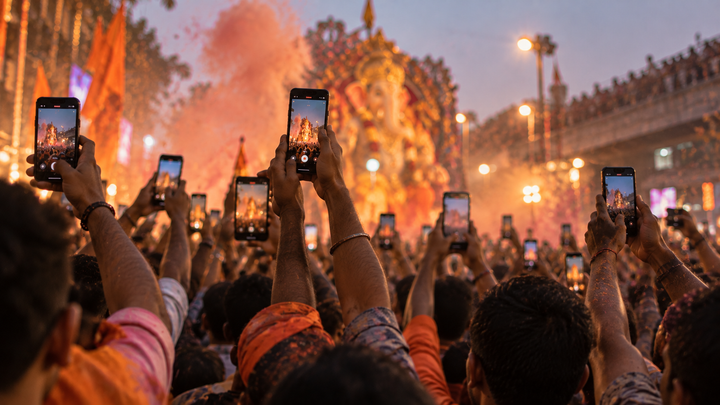
A procession comes past, everyone lifts a phone, and someone's arm catches yours. The phone is on the ground for about a second before a foot moves it, and in a dense crowd that is the last you see of it.
Most phones lost in Indian crowds are not stolen. They are knocked out of a raised hand and then kicked out of reach, or they are left behind at a cloakroom. Theft is real and worth guarding against, but it is a different problem with different answers, and conflating the two is why most advice is useless.
Why a dropped phone in a crowd is usually gone
On an empty street a dropped phone is a repair bill. In a moving crowd three things happen in the first few seconds.
- You cannot stop. The people behind you keep moving, so you are carried past the spot before you can react.
- It gets kicked. A phone underfoot travels, usually in the direction of flow, and usually out of sight immediately.
- You cannot safely look for it. Which is the part that matters most.
Never bend down to pick something up in a dense moving crowd. Crowd-safety guidance is consistent on this, and it is the mechanism behind a great many crush injuries: one person stops and crouches, the people behind cannot see or stop, and a pile-up starts. A phone is not worth it. If you drop something in a packed crowd, keep moving and step out to the edge first.
Ganesh visarjan is where this is at its sharpest, because the procession ends at water and adds a second, worse failure mode on top of the first. We have covered that day on its own in Ganesh Visarjan and your phone.
Where it actually happens
| Situation | How the phone goes | What helps |
|---|---|---|
| Procession or parade | Arm raised to film, someone knocks your elbow | Tether, film at chest height rather than overhead |
| Temple queue barriers | Phone set on a rail or ledge while you adjust bags | Never put it down; pockets, not surfaces |
| Cloakroom or shoe counter | Handed over in a bag, or forgotten at collection | Keep the token, check contents before leaving the counter |
| Narrow market lanes | Phone out for navigation, shoulder contact from both sides | Step into a doorway to check the map |
| Crowd surges at entry gates | Hands occupied, phone in a loose pocket | Front pocket, zipped if possible |
| Night festivals | Low light, uneven ground, phone as a torch | Tether, and accept you will be jostled |
Cloakrooms deserve their own note
Many temples require phones to be left at a counter, and the loss there is rarely dramatic. It is a mismatched token, a bag handed to the wrong person, or a phone simply not returned in the rush at collection.
Three habits cover most of it. Keep the token somewhere that is not the bag you handed over. Photograph the counter number and the token before you walk away, using someone else's phone if yours is the one going in. And open the bag at the counter rather than fifty metres later, because a discrepancy is solvable there and not afterwards.
Theft, briefly, because it is the other half
Crowds do also produce theft, and the mechanics are different: a bump you barely register while the phone is in a back pocket, or a grab while it is in your hand at the edge of a lane.
The short version is front pocket when stowed, tethered when out, and let go if someone pulls. We have written the long version in phone snatching in India, along with what to do afterwards, and there is no point repeating it here.
What a tether does and does not cover
It covers the phone while it is in your hand, which is when the knocked-from-a-raised-arm loss happens. That is the most common crowd loss and the one with the worst outcome, so it is a reasonable fit.
It does nothing for a phone in a cloakroom, nothing in a back pocket, and nothing if someone pulls hard, in which case you should let go anyway. In a crowd it has one additional benefit that is easy to miss: you do not have to bend down.
Frequently asked questions
What should I do if I drop my phone in a crowd?
Do not crouch or bend down while people are still moving around you. Keep moving with the flow, step out to the edge, and only then look back. Bending in a dense moving crowd is how crush injuries begin, and no phone is worth that risk.
Are phones usually stolen or dropped at Indian festivals?
Both happen, but being knocked out of a raised hand while filming is the more common way a phone is lost, and the harder one to recover from because the phone travels underfoot immediately.
How do I keep my phone safe in a temple queue?
Do not set it on rails, ledges or barriers, even briefly. If there is a cloakroom, keep the token separate from the bag you handed in, and check the contents at the counter before you walk away.
Is a wrist tether useful in a crowd?
For the moment the phone is out and raised, yes. It keeps a knocked phone at your wrist rather than underfoot. It does nothing for a stowed phone and is not a defence against someone pulling.
What is the safest way to film a procession?
At chest height with both hands rather than raised above your head. The overhead shot is where elbows collide, and it is also where you have the least control of the phone.
A knocked phone stays at your wrist. See how PHLOOP works →
Related reads

Enjoyed this? Get the next one.
Join the PHLOOP list for new guides, product drops, and announcements. No spam.
Keep reading