Phone Lanyards in India: Neck, Crossbody and Wrist Compared (2026)

"Phone lanyard" covers three products that look similar in a listing photo and behave completely differently on a crowded platform: a cord round your neck, a strap across your body, and a short loop on your wrist.
All three stop a phone reaching the floor. The difference is where the phone ends up afterwards and what else it hits on the way. Neck and crossbody lanyards leave the phone swinging at chest or hip height; a wrist lanyard keeps it at your hand. In a dense Indian crowd, that is the whole decision.
The three types
1. Neck lanyard
A cord around the neck, the phone hanging at chest height. The format everyone knows from conferences and ID badges.
Fine for a day at an event. As a daily habit the weight sits on the back of your neck, the phone swings with every step, and a cord around your neck in a crowd is something that can be pulled. Most people who try one for commuting stop within a week.
Cost in India: ₹150-₹800. Best for: events, badge situations, short days.
2. Crossbody lanyard
A long strap, usually 100 to 140 cm, worn across the body with the phone at hip or chest height. Hugely popular for travel and festivals because it frees both hands.
The honest drawbacks: the phone swings into door frames, turnstiles and railings, and you are visibly wearing your phone, which is not always what you want on a street after dark. We compared it directly against a tether in phone tether vs crossbody lanyard.
Cost in India: ₹300-₹2,500. Best for: travel days, markets, hands-free navigation.
3. Wrist lanyard
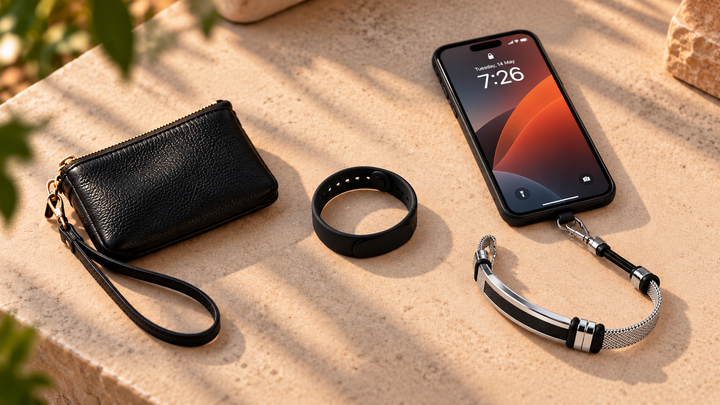
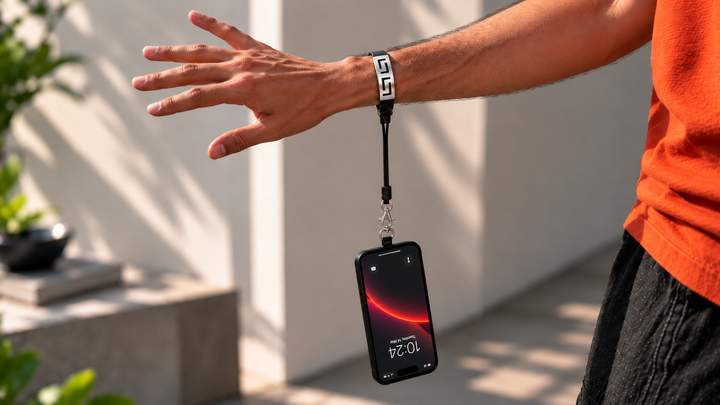
A short cord from the phone to a loop or bracelet on the wrist. The phone stays in or near your hand. Some listings call this a wrist strap or phone tether; it is the same thing.
It does not free your hands the way a crossbody does. What it does is keep the phone out of everyone else's way and in your control, which is what matters in a metro at rush hour.
Cost in India: ₹150 for a basic loop, ₹499 and up for a bracelet-style tether. Best for: commuting, crowds, water, daily use.
Side by side
| Neck | Crossbody | Wrist | |
|---|---|---|---|
| Stops a drop? | Yes | Yes | Yes |
| Hands free? | Yes | Yes | Partly |
| Phone swings into things? | Yes | Yes, most | Rarely |
| Good in a packed crowd? | No | No | Yes |
| Wearable all day? | No | Sometimes | Yes |
| Visibly carrying a phone? | Yes | Yes | No |
The crowd problem
Neck and crossbody lanyards were designed in places where you have personal space. An Indian local train, a festival procession or a temple queue does not offer any.
A phone hanging at hip height in a dense crowd catches on bags, gets pressed against strangers and swings into poles when the train brakes. A phone at chest height on a neck cord is at exactly the height people's elbows are. Neither is dangerous, but both mean the phone takes knocks the lanyard was supposed to prevent.
A wrist lanyard keeps the phone inside your own footprint. That is why it is the better daily choice for most Indian commutes, and why crossbody lanyards are better kept for travel days with more room.
What to check on any lanyard
- How it attaches to the phone. A tether tab that slides inside the case at the charging port carries real load with no adhesive. Stick-on pads loosen in heat and sweat.
- The clasp. Cords rarely fail. Clasps do. Look for steel, and a stated load rating in kilograms.
- A quick release. Any lanyard that goes round your neck should break away under a hard pull. That is a safety feature, not a flaw.
- Wireless charging. Anchoring at the charging port leaves the back of the phone clear.
If you want the wrist option
A plain wrist loop works, but tends to come off and stay off because it looks like equipment. PHLOOP is a wrist lanyard built as a bracelet, so it is already on when you need it: a 10 kg-rated cord, a 316L steel swivel clasp, no adhesive, from ₹499.
Frequently asked questions
What is a phone lanyard?
A cord or strap that connects your phone to your body so it cannot fall. It can go around your neck, across your body, or around your wrist.
Which phone lanyard is best for commuting in India?
A wrist lanyard. Neck and crossbody lanyards leave the phone swinging at chest or hip height, where it catches on bags and people in a crowded train or bus.
Are neck lanyards safe?
For short use, yes, but choose one with a breakaway clasp so it releases under a hard pull. A cord that cannot release around your neck is a risk in a crowd.
Is a crossbody phone lanyard good for travel?
Yes, especially on days with room to move and a lot of map use. It frees both hands. In very dense crowds the swinging phone becomes a nuisance.
Is a wrist lanyard the same as a phone tether?
Yes. Wrist lanyard, wrist strap and phone tether all describe a short cord from the phone to your wrist.
The lanyard that stays inside your own footprint. See how PHLOOP works →
Related reads

Enjoyed this? Get the next one.
Join the PHLOOP list for new guides, product drops, and announcements. No spam.
Keep reading